
Do Golf Carts Have VIN Numbers? Here's the Answer!
Learn everything about golf cart VIN numbers, how to locate them, and their importance for titles and registrations. Find out more here.
Golf Cart Titles and VIN Numbers: Understanding the Connection
When discussing vehicle identification, one question often arises: do golf carts have VIN numbers? The answer isn't as straightforward as it might seem, as it depends on the type and purpose of the golf cart. In this guide, we'll explore the role of VIN numbers in golf carts, their connection to titles, and how to locate and decode these identifiers. Whether you own a standard golf cart or a low-speed vehicle (LSV), understanding VIN numbers is essential.
Standard Golf Carts and VINs
Standard golf carts typically do not have VIN numbers in the same way cars do. Instead, they come with serial numbers, which manufacturers use for identification and tracking purposes. Serial numbers are unique to the cart and can often be found on a plate or sticker attached to the cart's frame or dashboard.
Unlike low-speed vehicles, standard golf carts are primarily designed for use on private property, such as golf courses, and are not meant to be driven on public roads. As a result, they don't require titles or registration, and therefore a VIN isn't necessary.
Low-Speed Vehicles (LSVs) and VINs
Low-Speed Vehicles (LSVs) are a category of golf carts that are equipped to operate on public roads, provided they meet certain criteria. These vehicles must comply with federal safety standards, which include having a VIN number. A VIN serves as a legal identifier for the vehicle, allowing for registration, titling, and insurance purposes.
LSVs are often equipped with safety features like headlights, taillights, turn signals, seat belts, and mirrors. These additions make them roadworthy and eligible for a VIN number, distinguishing them from standard golf carts.
The Connection Between Titles and VINs
The relationship between titles and VINs is crucial for LSVs. A VIN number is required to obtain a title, which serves as proof of ownership. If you own an LSV, the VIN number is typically found on a plate near the steering column or under the dashboard. This number is used when applying for a title and during registration with your local Department of Motor Vehicles (DMV).
For standard golf carts without a VIN, titling isn't usually necessary. However, certain states may require registration, especially if the cart is used on public property. In such cases, the serial number may serve as an identifier.
Obtaining a Title for an LSV with a VIN
To obtain a title for your LSV, you need to provide the following:
- The vehicle's VIN number
- A completed application for title and registration
- Proof of ownership (such as a bill of sale)
- Payment for applicable fees
Check with your local DMV for specific requirements, as regulations can vary by state. Titles ensure that your LSV is legally recognized and protected against theft or fraud.
Check Your VIN
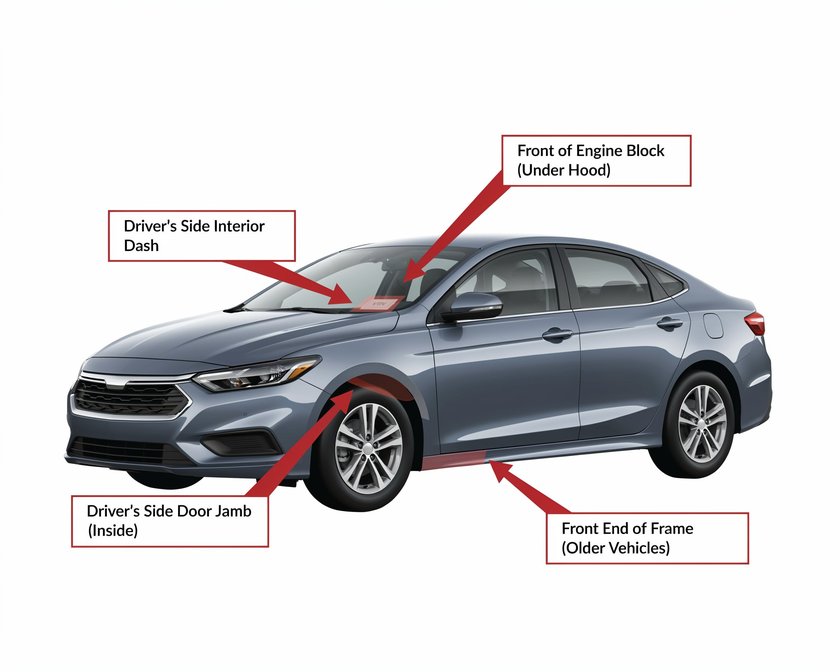
How to Find the Serial Number on Your Golf Cart
Locating the serial number on your golf cart is essential for maintenance, repairs, and resale. Here are common locations for different golf cart models:
E-Z-Go RXV Golf Cart (2008 – Present)
The E-Z-Go RXV Golf Cart, introduced in 2008, features modern design and technology. Locating the serial number on this model is straightforward:
- The serial number is typically located on a metal plate beneath the passenger-side glove box.
- Look for a metal tag or sticker affixed to the cart's frame near the glove box area.
- The plate may also include manufacturing details, such as the year and model of the cart.
Knowing the serial number can help identify the exact specifications and year of manufacture of your RXV, making it easier for maintenance or resale.
E-Z-GO TXT Golf Cart (1996 – Present)
The E-Z-GO TXT Golf Cart has been a reliable choice since its introduction in 1996. To find the serial number on this model:
- Check beneath the driver's seat; the number is often stamped on the cross beam of the cart's frame.
- Inspect the passenger-side glove box for an additional metal plate or sticker.
- The serial number typically consists of a combination of letters and numbers that denote the manufacturing year and model type.
Locating the serial number is essential for accurate servicing or ordering replacement parts.
E-Z-GO Marathon Golf Carts (1975 – 1993)
The E-Z-GO Marathon Golf Cart is a classic model popular from 1975 to 1993. Finding the serial number can involve checking multiple areas:
- Look inside the passenger-side glove compartment for a metal tag.
- If not visible, check under the driver's seat near the hinge for a stamped plate.
- Older models may have the serial number engraved directly onto the cart's frame near the rear axle.
Because the Marathon is no longer in production, having the serial number can be critical for finding compatible replacement parts or verifying its authenticity as a vintage cart.
E-Z-GO Workhorse (1996 – Present)
The E-Z-GO Workhorse, known for its rugged utility features, has been in production since 1996. To locate the serial number:
- Inspect the frame near the rear axle for a metal plate with the serial number.
- In some models, the plate is mounted under the driver's side seat or dashboard.
- The serial number may also include a prefix indicating the model type and production year.
The Workhorse's serial number is useful for identifying its specific load capacity and configuration options.
E-Z-GO ST Golf Cart (1996 – Present)
The E-Z-GO ST Golf Cart, suitable for recreational and utility purposes, has been a staple since 1996. Serial number location tips include:
- Look on the passenger-side dash for a metal plate with the serial number.
- If not found, check under the front cowl near the steering column.
- The serial number is often paired with a manufacturing code that reveals production details.
Identifying the serial number helps when upgrading or customizing your ST Golf Cart.
E-Z-GO MPT Golf Cart (1996 – 2003)
The E-Z-GO MPT (Multi-Purpose Truck) Golf Cart, produced from 1996 to 2003, is known for its versatility. To find the serial number:
- Inspect the driver's side dashboard for a metal plate or sticker displaying the number.
- Check the cart's frame near the rear axle for a secondary serial number location.
- Ensure the number is readable, as it can fade or wear out over time.
The serial number provides insight into the cart's specific features, making maintenance or modifications easier.
E-Z-GO Medalist Golf Cart (1975 – 1993)
The E-Z-GO Medalist Golf Cart, a popular choice from 1975 to 1993, features a sturdy design. To locate the serial number:
- Check inside the glove box on the passenger side for a serial number plate.
- If not found, look under the driver's seat, particularly near the hinge area.
- In some cases, the serial number may be engraved on the cart's frame or a metal tag near the front axle.
Having the serial number is crucial for verifying the cart's model year and for sourcing parts compatible with this older model.
Run a Free VIN Check
Pull the real history behind any car — recalls, title brands, odometer trail.
Related Articles

Car Battery Lifespan: How Long Do Car Batteries Last? - ChassisVIN
Understand car battery lifespan. Discover the factors that impact it. Get tips to extend your battery's life and how to get a vehicle history report.

VIN Country Codes: Decoding Your Vehicle's Origin | ChassisVIN
Discover the VIN country codes. Learn how to identify where your car was made. Get a detailed guide to vehicle manufacturing origins and VIN structure.

Best SUVs with Captain Seats: Top 2024 Models | ChassisVin.com
Discover the best SUVs with captain seats in 2024. Get detailed reviews, comparisons, and find the perfect family SUV with extra comfort. Search your VIN now!
Ready to Decode Your VIN?
Get instant results, completely free. No account needed.